I have finished the cardigan sweater I was knitting for my GS. Now, I started this project in October 2009, well ahead of this little boy’s anticipated arrival. I had always intended to knit it as a size 12 months — I just hadn’t intended for him to be 9 months old by the time I finished! Ah…best intentions, too much ambition …and too many other WIPs to distract me.
Actually, I knit the cardigan in about 3 months. I had started this project planning to knit both a romper and a cardigan to match. I had the romper about three-fourths complete when I decided that it wasn’t what I wanted for my GS. So I set it aside for a bit and then realized I better get busy knitting or the sweater would be too small before it was ever finished.
Here’s the little guy in the sweater:
He’s a real cutie, isn’t he? Not that I’m a proud Grandma or anything like that…. 🙂
Brief run-down on the project details: Pattern was from a Dale of Norway pattern booklet, Nr. 203 “Baby Designs”. Yarn was Dale of Norway Baby Ull — colorways 4221 (red), 5735 (navy), 6435 (teal). The body is done in a three color, slipped stitch pattern, which I identified from Barbara G. Walker’s “A Treasury of Knitting Patterns” as the waffle weave. I will post about this pattern later.
Here’s a link to all the project details in my Ravelry projects: GS’s Cardigan.
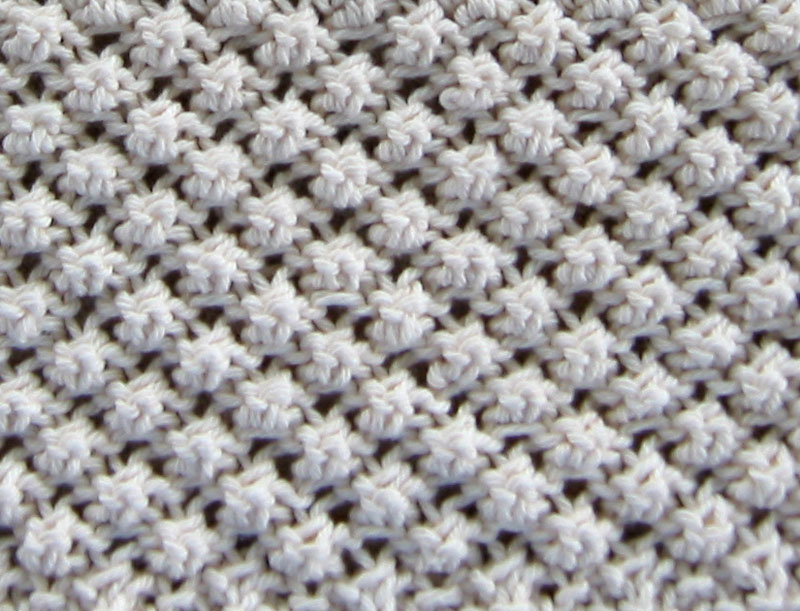
I used the Trinity Stitch pattern for dishcloth # 6. This stitch pattern produces a lovely textured fabric and is relatively easy to do. It is also known as the Cluster Stitch or Bramble Stitch. The fabric produced has a “knobby” texture and would make a lovely scarf or hat. It could also be used as part of the textured patterning in an Aran style or Fisherman style sweater or as a panel mixed with other textured patterns in an afghan or shawl.
The pattern is a multiple of 4 stitches done over 4 rows:
Row 1: (Right side) – Purl
Row 2: *(K1, P1, K1) all in same stitch, P3tog. Repeat from * across.
Row 3: Purl
Row 4: *P3tog, (K1, P1, K1) all in the same stitch. Repeat from * across.
Repeat these 4 rows for the desired length of your fabric.
The subtitle for this book is “mastering fit + plus-size style + 15 projects”. The first two chapters of this book cover the basics of how to knit garments that fit. While the focus is on plus-size, the information is applicable to any knitted garment. The information in these two chapters is worth the price of the book if you are wanting to learn more about how to modify patterns so that they actually fit your body. Chapter One discusses the common elements of a sweater and “what they mean to you” and Chapter Two covers the use of measurements and how to redesign patterns for a custom fit.
The remaining five chapters cover different types of sweater styles: The Drop-Shoulder, the Set-In Sleeve, The Raglan, The Seamless Yoke, and The Dolman. There are three projects for each type and these are really lovely designs for us plus-size gals. Each project also has helpful notes for the knitter. So this book is both a “how-to” guide and a set of 15 plus-size patterns. And some of those patterns are the sort that makes a knitter’s fingers itch to pull out some yarn and needles and get started. The “Poppy Cardigan” on page 67 is on my list of future projects for sure.
If you are interested in this book, click on the picture at the top of this post. It will take you to the book on Amazon.com.
It took me a good bit of time to decide if I thought it was necessary to knit swatches in the round if I was knitting an item in the round rather than flat. The practice of knitting sweaters flat in pieces that are sewn together versus knitting sweaters in the round is, in itself, a whole topic with proponents for each practice. I may take this topic up at a later time, but for now I will focus on knitting a swatch in the round.
First, there are many knitters and designers who only use gauge swatches knit flat to determine their stitch gauge even if the pattern is knit in the round, and second, most patterns do not state how the gauge swatch was done. All you see in the pattern is the gauge statement.
Do you know if your gauge is the same if you knit in the round as when you knit flat? There’s a good chance that it’s not. As I’ve said before, gauge is a measure of how an individual knitter knits.
Think about how you knit when you knit in the round. One of the biggest differences is that you only knit on the right side of the fabric when you knit in the round. Using stockinette stitch as an example: When you knit flat, you knit one row (right side) and then turn your work and purl the next (wrong side). When you knit in the round, you join the stitches to make a circle and then knit every round.
Now, if you are one of the many knitters whose purls are looser than their knits, there is going to be a difference in tension between something you knit flat and something you knit in the round. Plus, you may modify your technique for knitting when knitting in round from when you knit flat. If you use straight needles when knitting flat, then switch to using circular needles or double point needles (dpns) to knit circular – your gauge may be significantly different. This is why I have come to the conclusion that it is good practice to swatch in the round when planning a project that will be knit in the round.
So how does one knit a swatch in the round? The first method is to cast on a enough stitches to give you a knitted tube that will be at least 4+ inches when laid flat. This could be the start of a sock or a hat. (Elizabeth Zimmerman said that “a hat makes a good swatch”.) Once you have a tube knitted of sufficient length for a good measurement, you treat this swatch the same way you would if your swatch that was knitted flat – i.e. measure, block, re-measure.
The second method goes by a couple of different names: “Speed Swatch” and “Circular Swatch with Floats” are two that I have found in my research. In this method, you use a circular needle and cast on the same number of stitches you would if you were knitting flat. But instead of knitting a row and then turning the swatch and knitting back to the end of the row, you slide your stitches to the needle on the opposite end and strand the working yarn loosely across the back and start knitting the next row. You keep repeating this process until you have a long enough swatch for good measurements. See pictures below:
Front of Swatch ITR — Knit with US 8 and Us 7 Needles
Back of Swatch ITR
Once you have the swatch completed, you treat it the same way as any swatch – measure unblocked, block, re-measure. A note about measuring this swatch: Some sources suggest that it is easier to measure this swatch after cutting the loose strands so that the swatch will lay flat. Others simply say to measure the swatch by laying it as flat as you can. Logically, you are not going to want to cut the strands if you plan to reuse the yarn in the swatch. I’ve tried both ways and did not find a significant difference in measurements. Here are pictures of the swatch above after I blocked it and cut the floats to take the measurements:
So if you plan to knit a sweater in the round, please do your swatch in the round.
If you would like to see a video on this technique, here are three helpful ones:




Wow! That looks even better on the darling GS! I love this pattern and how the different colors really make the pattern pop!