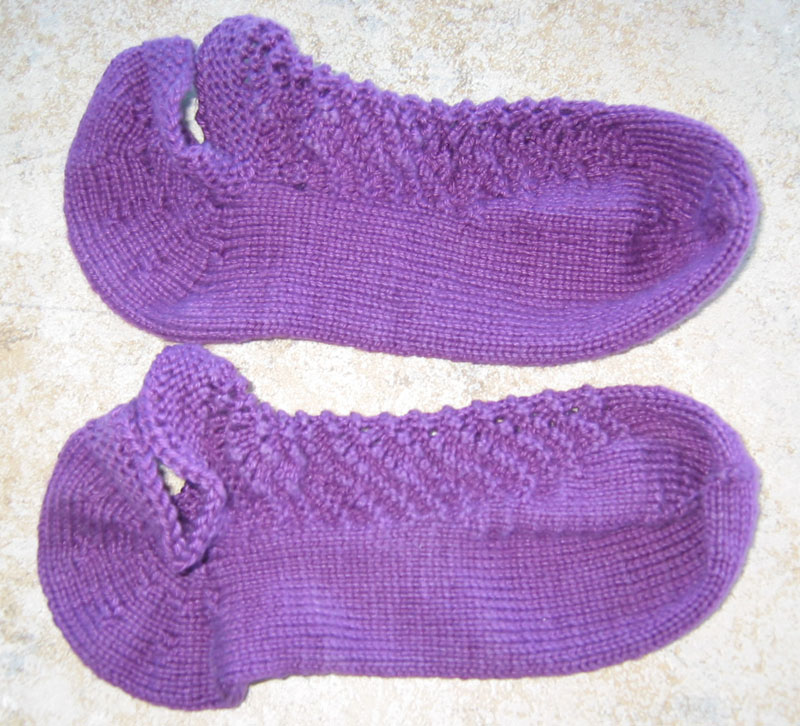
FO: Cable Rib Socks

Knitted Cable Rib Socks

I finally finished the Cable Rib Socks! Yes, this is the unfortunate pair of socks that was eaten by the Roomba. (See post here.).

I set this project aside for some time to work on other project. Typically for this kind of project, I would pick it up every now and again, but not spend much time on it — thus, progress was very slow. In addition, every since the Roomba incident, this pair of socks seemed to be prone to problems (errors?) — in fact, I think I frogged each sock back several rows at least twice. So, it is nice that they are finally done — and I am happy with the result.
Cable Rib Socks

The socks fit well, and they look nice on my feet. They were knit in Knit Picks Risata, Baby Doll colorway — it’s a nice cotton sock yarn and I love the bright rosy pink color. Pattern was Cable Ribbon Socks by Classic Elite Yarns.

1 thought on “FO: Cable Rib Socks”

Comments are closed.

Related Post

Master Knitter Level I – Swatches #4, #5, & #6 – IncreasesMaster Knitter Level I – Swatches #4, #5, & #6 – Increases

Swatches 4 through 6 in the Master Knitter Level I program are all about increases. Specifically, each swatch demonstrates a particular type of increase. The increases are done on each side, with three stitches before the right edge increase and three stitches after the left edge increase.

Bar Increases

Swatch 4 - Bar Increase

Swatch 4 demonstrates the Bar Increase. This is probably the increase most knitters first learned to make when knitting. It often written as “KFB” in patterns — which means “Knit in the front and back loops”. When you knit into the front loop of a knit stitch and then knit in the back loop of the same knit stitch, the resulting increase has a purl bump where the second stitch was made. It is clearly visible as you can see in this picture.

I learned a few things working on this swatch. Since I am now much more aware of my tension, I found that the purl bumps looked much better if I made certain I kept the tension even with both stitches. It’s much the same issue as when I had trouble getting even tension in ribbing.

Also, through my research, I learned that you should never make your increases on the very edge of your knitting — you should have at least one stitch on the edge before doing the increase. This makes it much easier and neater to do seams. This is something to pay attention to when you are knitting pieces that will be sewn together — I know I will practice this in my future knitting projects.

Swatch 5 - Knitted Make 1 Increases

Swatch 5 - Make 1 Increases

Swatch 5 demonstrates Make 1 increases. On the right edge, I knit an M1R increase — which means “Make 1 Right” — this is a right-slanting increase. It is made by inserting the left needle from the back and lifting the horizontal strand between stitches onto the left needle and knitting into the front of this strand.

On the left edge, the increase is an M1L — which means “Make 1 Left” — a left-slanting increase. It is made by inserting the left needle from the front and lifting the horizontal strand between stitches onto the left needle and knitting into the back of this strand.

M1 increases are tighter and there is no purl bump on the front of the knitting.

Swatch 6 - Lifted Increases

Swatch #6 - Lifted Increases

Swatch 6 demonstrates the Lifted or Raised Increase. This is the most invisible of increases — and was an increase I had never used before, so the entire swatch was a learning experience.

Again, I knit a right-slanting increase on the right edge. This increase is done by lifting the stitch below the stitch on the left needle and knitting it.

The left-slanting increase on the left edge of the swatch gave me the most difficulty. I had to search out several different pictures of it in my references before I figured it out. The left-slanting lifted increase is done by lifting the stitch below the stitch just knitted on the right needle and then knitting it.

The best pictures and explanations I found of this increase, as well as the others, were in an online article at Knitty.com, entitled “Techniques with “Theresa – Increases”.

So, these three swatches improved my technique when knitting increases and I learned a method of increasing that I had never used before. Check out the article on Knitty.com if you want to explore these methods.

Summer KnittingSummer Knitting

I’m back after a 9 week hiatus. Life sometime intervenes in personal activities and I haven’t had time to blog since just after my son’s wedding. Things seem to be settling down and since we have hit that time of the summer when there’s not much on TV to watch, I may have some time in the evenings to work on my blog and my website.

For the next few posts, I’m going to focus on the topic of “Summer Knitting”. Summer is that time of year when I like to have a few smaller projects going on my needles. Small projects are very portable and can be easily tossed into the car or suitcase when heading out of town on a trip. These projects also need to be fairly simple patterns — I don’t like having to concentrate on a complex pattern when traveling or sitting with friends/relatives.

My first summer knitting project was a knitted doily. Knitted doilies are a bit of novelty for me — since I also crochet, I have always crocheted my doilies and never really gave much thought to the possibility that doilies could also be knitted. However, I have recently discovered two lovely patterns for knitted doilies on the web and I knit them up using size 10 crochet cotton thread and size US 3 needles.

Doily 1 is “Liz Snella’s Heirloom Doily”. Finished it measured 12 inches in diameter. I used double point needles to start and then switched to a 24 inch circular needle. As with all doilies, this pattern knit up quickly and I was able to finish it in a couple of evenings.

Doily 2 is named “Doily with Star”. Finished it measured 10 inches in diameter. With this doily, I used two circular needles rather than double points and a circular needle. Again, I was able to finish this doily in only a few hours of knitting.

I gave both of these doilies to my MIL for Mother’s Day. She was delighted – and since she doesn’t knit, she was also surprised that I had knitted them rather than crocheted them.

So – if you are looking for a small summer project: try knitting a doily. It’s a great way to practice using double points and/or two circular needles. I’ve included links to the two patterns below.

Happy knitting. Lindy

Part 1: Freeing Yourself from a Written Pattern or How to Use the Yarn of Your ChoicePart 1: Freeing Yourself from a Written Pattern or How to Use the Yarn of Your Choice

In my last post, I discussed the issues related to trying to substitute one yarn for another and suggested at the end of my post that if you want to use a yarn of a different weight & gauge than what the pattern calls for – you can design your own custom sweater using the pattern as a guide.
Today, I will focus on the first of two approaches for doing just that. WARNING – you must be prepared to take measurements, do a proper gauge swatch and get out your calculator. Yes, we will be doing some math…

Approach #1 – Use EZ’s Percentage System.

Elizabeth Zimmerman published her “unvented” percentage system for designing sweaters in the Knitting Workshop and gave us many examples of how to use it in her other books. EZ was always someone who dealt with knitting in a pragmatic fashion and basically cut through all the fluff and gave clear explanations of basic concepts. I encourage you to read all of her books – but if you want the complete explanation of her percentage system — Knitting Workshop is the source.

I am describing EZ’s Percentage System for two basic sweater designs – the yoke sweater and the Raglan sleeve sweater. Both are knitted in the round. You need to take some basic body measurements:

Width around the chest (Chest Measurement) [CM] The Chest Measurement is the “Key Measurement” (100%) and the starting point.
Body length to Underarm (Underarm Measurement)
Sleeve length to Underarm (Sleeve Length)
You must know your stitch gauge or Stitches per Inch [SPI]

The math follows:
CM X SPI = # stitches needed for the body of the sweater.

For a Yoke Sweater the basic percentages of the above are:
Body = 100%
Wrist = 20%
Upper Arm = 33%
Underarm = 8%
Circumference of Shoulders = 133%
Neck = 40%

For a Raglan-Sleeve Style Sweater the basic percentages are:
Body = 100%
Wrist = 20%
Upper Arm = 33%
Neck = 40%

To calculate – multiply the total number of body stitches by the percentage.

I think you get the idea. If you want to try using EZ’s percentage system, I recommend you either borrow EZ’s Knitting Workshop from your library or a friend or purchase it.

Here’s a link that will take you to Amazon.com: Knitting Workshop

I have also created an Excel Spreadsheet that will make the calculations for you. You can download it here: EPS_Calculator Spreadsheet.

Next post, I will outline another approach to sweater design.