In honor of EZ’s Brithday: Baby Surprise Jacket KAL

Elizabeth Zimmerman’s 100th birthday was August 9. One of our expert knitters in the Nebraska Knit & Crochet Guild (NKCG) started a knit-a-long (KAL) of the “Baby Surprise Jacket” in honor of EZ’s birthday. I had never done this baby sweater pattern, so I joined in the KAL.

It turned into on of those obsession driven projects. You know the ones — where you become so intrigued by how the pattern is unfolding that you simply.cannot.put.it.down. Yup, your fingers just itch to knit and your brain refuses to think about anything else — especially mundane things like laundry, cooking and other housework. That’s what this little project became.

You see, the BSJ is knit entirely of garter stitch and involves a series of increases, decreases and center double decreases to make your knitting go at right angles. It is knit in a single piece — and the fascinating thing is that it turns into a sweater without the normal sweater type shaping that you usually do. As I knit this project, I kept marveling at the ingenuity of the designer — how in the heck had she figured this out? It’s a combination of understanding geometry and the shaping required for a baby sweater — and EZ was someone who took theoretical concepts like right angles and turned them into pragmatic knitted garments. Perhaps a few pictures will help.

When you finish knitting the pattern — you end up with an oddly shaped piece of garter stitch fabric that looks like this:

Garter stitch fabric - Baby Surprise Jacket

As you can see, I knit this with two different yarns to create stripes. Now, when you fold the edges together, this striped fabric turns into this:

Baby Surprise Jacket, folded

A jacket. That’s the surprise — it actually turns into a little sweater jacket with nifty right angle striping on the front and horizontal striping on the back. And — there are only two seams to sew! Just two — the sleeves at the top. The button band is done as part of the bottom of the knitted piece, so you just add buttons and you are finished. (I’m still looking for buttons, so I don’t have a photo of the finished jacket.)

Now, the written pattern is somewhat confusing at first. There are several resources available to help sort out the sketchy instructions given in both the Knitter’s Almanac and Knitting Workshop. However, the biggest question I had was “if I knit this at a gauge of 6 stitches per inch, what size is my jacket?” EZ just tells you it will fit an infant if you knit at that gauge and if you knit it at a gauge of 5 stitches per inch, you will get a bigger jacket that will fit a larger child about 1 year old. This is this question that seems to cause knitters the most problems.

I knit this BSJ using Dale of Norway Baby Ull, which is a fingering weight wool yarn and my gauge was 6 spi. The jacket measures 15.25 inches across the chest, just at the point where the underarm is. Looking at a standard body measurements chart for baby sizes, This jacket is a 0-3 months size.

Now this sizing issue really bugged me — so I had to figure out the sizing for different gauges and correlate them to actual baby sizes. (Yes, I am a geek.) After studying the pattern, I discovered that the chest measurement is at the point in the pattern where you are knitting 90 stitches. (90 divided by 6 equals 15). So, using this point of reference, I have calculated roughly what the corresponding size will be if the BSJ is knitted at gauges of 5.5 spi, 5 spi, & 4.5 spi. I put this into a table to help others who might be bugged by this question:

Gauge Chest Measurement Size
6 spi 15-16 in. 0-3 mos
5.5 spi 16-17 in. 3-6 mos
5 spi 18 in. 12 mos.
4.5 spi 20 in 18 mos.

References:
Pattern: Ez’s instructions for the Baby Surprise Jacket can be found in Knitter’s Almanac or Knitting Workshop and/or it can be purchased from Schoolhouse Press.

Row Counter: A handy tool for keeping track while knitting the BSJ can be found here: http://www.box.net/shared/eugvsfb3lt

Video: There is a six-part video series on the BSJ, here is the link to the First Episode.

Ravelry Knitters — there is also a Rav Group for the BSJ.

1 thought on “In honor of EZ’s Brithday: Baby Surprise Jacket KAL”

  1. Wow. You’re done with yours. I’m still on Row 18. I’ll probably get to it this weekend when family is here. It’s a good chatty knitting project!

Comments are closed.

Related Post

How to Knit a Helpful Swatch – Part 2 Stitch PatternsHow to Knit a Helpful Swatch – Part 2 Stitch Patterns

In my previous post, I discussed how to make a preliminary swatch to select the size needle that gives you a fabric that you like and then how to knit a gauge swatch. The gauge swatch is measured to give you your stitch gauge (stiches per inch) and your row gauge (rows per inch).

At this point, you might think you are ready to cast on and begin knitting your sweater – BUT….

Are you planning on using some type of ribbing for the bottom, cuffs and neckline of the garment? Are you planning on using a certain textured stitch pattern, a lace pattern or cables in your sweater? Will you be combining two or more stitch patterns in the body of the sweater? If the answer to any of these questions is “yes”, then you need to do more swatching.

Swatches with Borders: Have you ever knit something with a definite edge made by knitting either garter stitch or seed stitch and then found that the edges curl? The reason this happens is usually due to a difference in gauge between the stitch pattern used for the border and the stitch pattern used for the body. Thus, if you are knitting piece with a border that is different than the body of the piece, knitting a swatch with the borders on it provides you with an opportunity to make adjustments to minimize or eliminate the problem.  Suzanne Bryan has a nice video on this that you may find helpful, here’s the link:

Short Rows in Garter or Seed Stitch Border

Note: I don’t recommend using garter stitch borders on gauge swatches even though others do. The border tends to distort the swatch and may affect the accuracy of your measurements.

Swatches of Ribbing: Ribbing by nature tends to “pull in”. Which means that 30 stitches of ribbing will have a smaller width than 30 stitches of stockinette stitch. How much of a difference can be quite significant and affect the way the garment fits around the hips and neck as well as around the wrists on a long sleeve. Also, some knitters find that their ribbing stitches appear larger than their stockinette stitches due to changes in tension. One solution for this is to use a smaller needle when ribbing – but if you do that you may need to have more stitches to get the right width of fabric for a proper fit. Knitting a swatch with your selected ribbing pattern followed by a transition to the stitch being used for the body of the sweater will provide you with the information you need to decide what you want to do. You might want to knit separate swatches with different ribbing patterns to select which ribbing you prefer to use in your garment. (You don’t have to use the same ribbing that the designer did for the pattern if you don’t want to…just saying.)

Swatches of Stitch Patterns:

In this post, stitch patterns refer to textured pattern stitches, lace patterns, cable patterns, etc. Basically any grouping of stitches that combine to make a pattern from the variations in stitches used.

I think making a swatch of the stitch patterns used in a written pattern provides a great deal of useful information about how the finished garment will look and feel – and fit! It’s also good practice before doing it as part of your finished item.

Keep in mind that most written patterns only give gauge in stockinette stitch and while that tells you what the designer’s gauge is – it does not tell you how the gauge changes in the stitch pattern(s) used in knitting the garment. If you find a written pattern that states the gauge of the stitch pattern – great. But does your gauge match that? Swatching is the only way you will know.

If you are only using one stitch pattern, then knitting a swatch with two or more pattern repeats will help you figure out how the pattern affects the width and length of the garment and what adjustment you might need to make to obtain the correct size of garment you want. If you combine it with your ribbing, you will see how the ribbing affects the transition to the main fabric of the garment.

If you are combining more than one stitch pattern within the main fabric of a garment, I recommend doing individual swatches for each stitch pattern to use as a gauge swatches.

Then to see what happens when the stitch patterns are combined,  you should do a swatch large enough to include all of the stitch patterns used in the order you plan to use them. This may end up being a very large swatch – even enough stitches for the back of your garment. This type of swatch will provide you with a lot of helpful information and give you insight into what adjustments you might need to make for a great fitting garment.  More on this in a later post.

Mirrored Cables – Front Cross & Back Cross CablesMirrored Cables – Front Cross & Back Cross Cables

Front Cross and Back Cross Cable Stitches are mirror images of each other. The Front Cross cable twists to the left, while the Back Cross twists to the right. Both cables are done over four stitches.

Mirrored Cables

In the sample – I have knitted a swatch with 3 Front Cross Cables and 3 Back Cross Cables to demonstrate how they mirror each other and also to show how these two cables would look in a ribbing. Remember that cables are usually separated by a few purl stitches in most textured pattern designs. In this swatch, I separated the cables by 2 purl stitches on each side. (I also blocked this swatch and stretched it to separate the cables. If you were using these cables as a ribbing, you would not want to block your garment this way.)

Front Cross Cable Stitches

The Front Cross Cable is often written in patterns as “C4F”. To knit this cable, you slip the first two stitches onto a cable needle and hold them in the front of your knitting while you knit the next two stitches. Then you knit the two stitches off the cable needle. This results in the cable twisting to the left.

Single Front Cross Cable
Tension can be an issue here, as many knitters tend to stretch the last stitch of the four a bit too much and end up with a looser stitch on the left edge of the needle. If you look closely at the left edge of the cable in the picture above, you will see that I do have looser stitches on the left edge.

Montse Stanley, in the “Knitters Handbook”, suggests knitting through the back of this stitch, rather than then front will tighten it up. You must remember to purl through the back loop again on the next row or you will have a twisted stitch if you do this, however.

Back Cross Cable
The Back Cross Cable is often written in patterns as “C4B”. To knit this cable, you slip the first two stitches onto a cable needle and hold them in the back of your knitting while you knit the next two stitches. Then you knit the two stitches of the cable needle. This results in the cable twisting to the right. The same tension issues occur with this cable as with the Front Cross Cable.

In my swatch, I have varied the number of rows between cable stitch repeats to demonstrate how the appearance of the cables changes with the number of rows. The first two cables are based upon a four row repeat (meaning that the cable was done on the fourth row) and the last two cables are based upon a six row repeat.

These two cable patterns are very versatile – uses include: all-over cable patterning in a sweater (the popular “baby cable” sweaters found in stores today), a border for another textured pattern in an Aran style sweater, a decorative ribbing for a pullover sweater, the patterning found in my Cable Rib socks. I’m certain you can find many more examples as you look through sweater and sock patterns.

Stitch Pattern: The Trinity StitchStitch Pattern: The Trinity Stitch

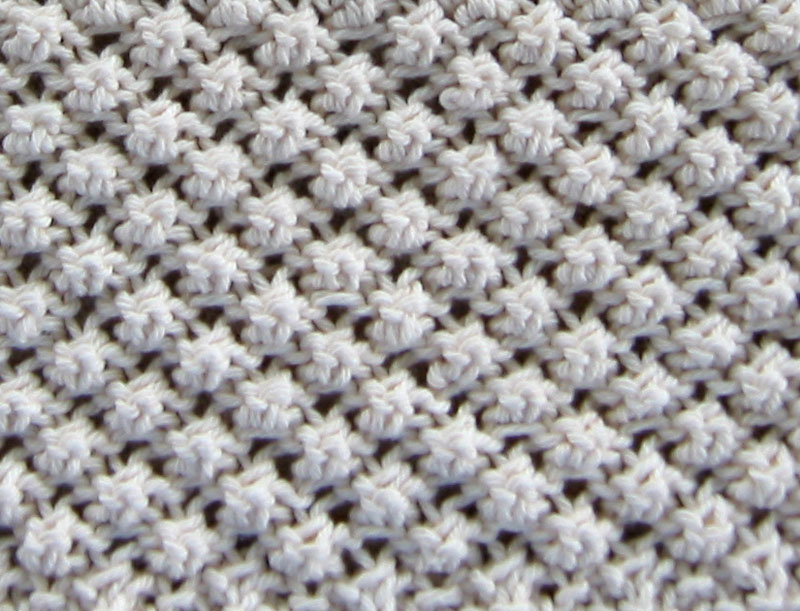
Knitted Trinity Stitch

I used the Trinity Stitch pattern for dishcloth # 6. This stitch pattern produces a lovely textured fabric and is relatively easy to do. It is also known as the Cluster Stitch or Bramble Stitch. The fabric produced has a “knobby” texture and would make a lovely scarf or hat. It could also be used as part of the textured patterning in an Aran style or Fisherman style sweater or as a panel mixed with other textured patterns in an afghan or shawl.

The pattern is a multiple of 4 stitches done over 4 rows:

Row 1: (Right side) – Purl
Row 2: *(K1, P1, K1) all in same stitch, P3tog. Repeat from * across.
Row 3: Purl
Row 4: *P3tog, (K1, P1, K1) all in the same stitch. Repeat from * across.
Repeat these 4 rows for the desired length of your fabric.

Reference: Barbara G. Walker, A Treasury of Knitting Patterns