Knitting Needle Sizes & Confusion

Knitting Needles sizes are fairly straightforward in the sizes that one uses for DK, worsted weight and bulky yarns. (Size US 4 and up). But it is a much different story when it comes to small diameter needles used to knit fingering, lace and other finer weight yarns. This can be very confusing – I just discovered that there is a significant variation in the sizing labels for some of these needles.

Let’s start with the standard “US” sizing – which uses a numerical designation for knitting needles, from “0000” up to 35 – with the needle diameter increasing as the numerical designation increases. Seems like a fairly straightforward system – until you run across US size 1 & 2 needles that are different diameters. If you never use a knitting needle smaller than US size 4 (which has a diameter of 3.5 mm), this will not be a problem for you. IF, however, you get into knitting socks and lace using much smaller diameter needles – it may cause you to pull out your hair.

Fortunately, most knitting needles sold today also come with their diameter size stated as well as their US size. What I have currently in my assortment of circular knitting needles are as follows: US Size 0 (2.00 mm); US Size 1 (2.25 mm), US Size 1 (2.50 mm), US Size 2 (2.75 mm), US Size 2 (3.00 mm). These needles have all been purchased in the last 10 years. I have seen patterns referencing size 1.5 needles, so I am guessing that the size 2 (2.75 mm) needle may also be a 1.5, but it’s difficult to tell for certain. Just a word of caution to those using patterns calling for these US sizes of needles – make certain your metric diameter matches the pattern (if it’s stated) and BE SURE to check your gauge!

I found two websites that have charts comparing the US sizing to the metric diameter:
http://www.fibergypsy.com/common/needles.shtml
http://www.lionbrand.com/cgi-bin/faq-search.cgi?store=/stores/eyarn&faqKey=97

Point to remember: Gauge is the measurement of the number of stitches per inch you get with a particular needle – this is more important than using the size of needle stated in a pattern. Always do a swatch for gauge!

1 thought on “Knitting Needle Sizes & Confusion”

Comments are closed.

Related Post

FO: Hermione’s Every Day SocksFO: Hermione’s Every Day Socks


I am happy to report that I have finished this pair of socks. This pair of socks has been very patient with me. You see, this is the pair of socks that has spent much time sitting in my car and waiting for me to knit on them at odd moments. I have occasionally taken them into my office and worked on them over the lunch hour. I have also taken them to my knitting guild meet-ups whenever I have forgotten to take any knitting with me in the morning. It was just one of those projects that I would pick up at different times, with no particular need to finish at a particular time or date.

Hermione's Every Day Socks on footHermione's Every Day Socks -- view of heel

The pattern, Hermione’s Every Day Socks is a free download on Ravelry. It’s a very popular pattern both on Ravelry and within my knitting guild. There are several things I like about this sock pattern: 1) It’s a very basic sock pattern with a nice heel; 2) the pattern is a simple 4 stitch, 4 row pattern that you can easily memorize — makes for an easy knit; 3) the toe-shaping is not too angular or pointy. Details: Yarn: Knit Picks Stroll, colorway: Duchess Heather. Needles: U.S. 2 (2.25 mm) Gauge: 6 spi.

Stitch Pattern: The Trinity StitchStitch Pattern: The Trinity Stitch

Knitted Trinity Stitch

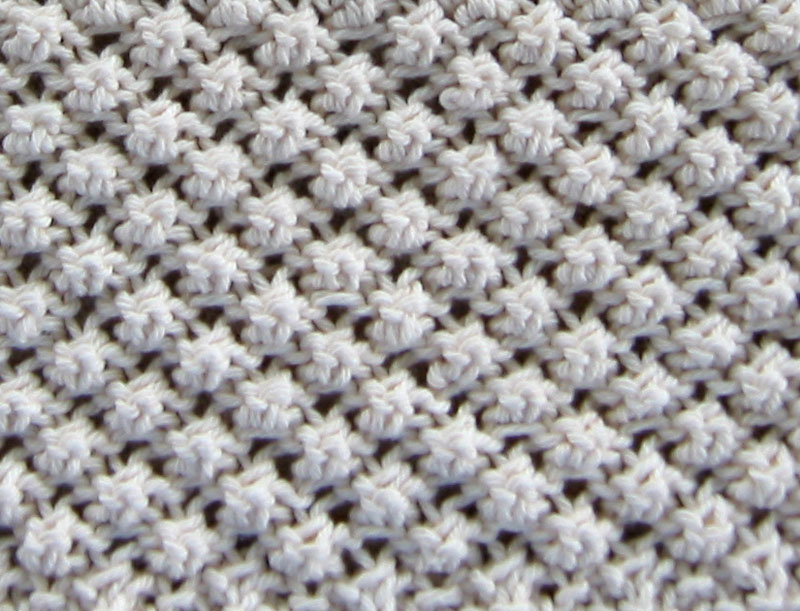
I used the Trinity Stitch pattern for dishcloth # 6. This stitch pattern produces a lovely textured fabric and is relatively easy to do. It is also known as the Cluster Stitch or Bramble Stitch. The fabric produced has a “knobby” texture and would make a lovely scarf or hat. It could also be used as part of the textured patterning in an Aran style or Fisherman style sweater or as a panel mixed with other textured patterns in an afghan or shawl.

The pattern is a multiple of 4 stitches done over 4 rows:

Row 1: (Right side) – Purl
Row 2: *(K1, P1, K1) all in same stitch, P3tog. Repeat from * across.
Row 3: Purl
Row 4: *P3tog, (K1, P1, K1) all in the same stitch. Repeat from * across.
Repeat these 4 rows for the desired length of your fabric.

Reference: Barbara G. Walker, A Treasury of Knitting Patterns

Acquiring Needles over TimeAcquiring Needles over Time

When I started knitting decades ago, the choices and types of knitting needles were limited. I started out using the Boye brand of aluminum straight single point needles in US size 10.5 – I think they were about 8 inches long. My next set of needles were US size 8 and were 14 inches in length. I continued acquiring single point aluminum needles – buying them one set at a time as I needed for the project I was working on. I still have most of those sets and I don’t use them much anymore.

I also acquired double point needles(dpns) as I learned to knit in the round or circular. These were purchased generally from big box type stores that carried knitting supplies. I have a mix of aluminum. bamboo, and birch needles. Again, I still have these needles but I rarely use them.

My first sets of circular needles were also purchased at big box stores and are aluminum or bamboo with thicker cables. I eventually found a local yarn shop in my area and this opened up a whole new avenue for buying knitting needles. The needles carried by the shop were of a much higher quality than what was available through the big box stores. My first purchases of fixed circular needles were Addi brand. Over time, I acquired a collection of these needles in various lengths. Again, I bought the size and length of needles as I needed them for projects.

I purchased my first set of interchangeable knitting needles about 25 years after I started knitting. I still use this set regularly but I also have acquired additional interchangeable needles and cables over time.

What I describe above is a process that I believe most knitters go through as they progress in the craft of knitting. You start out with what you are introduced to as a beginner and go from there. Today’s knitter has a much wider array of choices in knitting needles.

There are many different brands available as well as many different materials, not only aluminum and bamboo, but different types of woods, stainless steel, nickel, and acrylic. There are also many different options for where to buy knitting needles today. Knitters now have the option of buying knitting supplies online in addition to stores/shops in their area. It is wonderful to have so many different choices – but it can also be challenging for the new knitter.  In my next post, I will discuss tips for selecting needles that I hope will help you the next time you wish to buy a set of needles.